
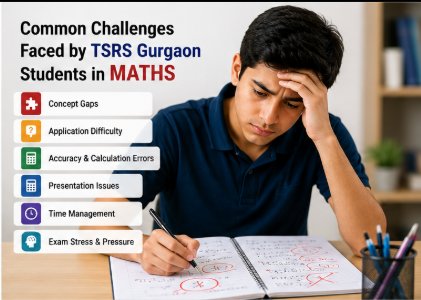
Common Challenges Faced by TSRS Gurgaon Students in Maths
Related: our ISC home tutors in Gurgaon page, with 12 free ISC Class 11–12 guides.
Common Challenges Faced by TSRS Gurgaon Students in Maths
Students studying in academically demanding environments can still experience difficulty in Mathematics. Strong classroom teaching does not automatically eliminate individual learning gaps.
A student may understand most classroom explanations but struggle with unfamiliar questions. Another may perform well during homework but lose marks in timed assessments. Someone else may have excellent conceptual understanding but make repeated calculation or presentation errors.
Recognising the exact nature of the difficulty is the first step towards improving Mathematics performance.
Challenge 1: Hidden Concept Gaps
Mathematics is cumulative.
A small weakness in one topic can become a much bigger problem later.
For example, difficulty with algebraic manipulation can affect functions and calculus. Weak understanding of trigonometric relationships can make later applications harder. Poor graph interpretation can affect functions, coordinate geometry and calculus.
This is why simply revising the current chapter may not always solve the problem.
A tutor should identify the underlying gap.
Challenge 2: Understanding Theory but Struggling With Application
One of the most common situations is:
"I understand the chapter, but I cannot solve the questions."
This usually means the student understands the explanation but has not developed enough transfer ability.
Transfer means applying learned knowledge to a different form of problem.
To build this ability, students should move gradually from:
- Worked examples
- Direct questions
- Modified questions
- Mixed questions
- Unseen problems
- Higher-order application
Challenge 3: Dependence on Memorised Methods
Memorisation can provide short-term support, but Mathematics becomes difficult when a question does not match the remembered pattern.
Students should therefore understand:
- Why a formula works
- What conditions apply
- When a method should be used
- When another method may be more efficient
This makes learning more flexible.
Challenge 4: Accuracy Problems
Some students lose marks despite knowing the correct method.
Typical causes include:
- Sign errors
- Arithmetic mistakes
- Copying numbers incorrectly
- Skipping intermediate steps
- Misreading conditions
- Incorrect notation
These errors can be reduced through deliberate checking habits.
A final two-minute review can sometimes prevent avoidable losses.
Challenge 5: Difficulty With Multi-Step Questions
Long questions can appear intimidating because they require several decisions.
Students should learn to divide them into smaller stages.
For every complex problem, ask:
What is given?
What is required?
What concept applies?
What should be found first?
What follows from that result?
This turns a large question into a sequence of smaller tasks.
Challenge 6: Time Management
A student may know how to solve a question but spend too much time doing it.
Timed practice is therefore essential.
However, timing should be introduced only after students understand the concepts.
A useful progression is:
Accuracy first → Efficiency second → Speed third
Speed without accuracy is not useful in Mathematics.
Challenge 7: Presentation
Mathematical communication matters.
Students should develop the habit of writing solutions in an organised manner rather than producing a collection of disconnected calculations.
A well-structured answer makes the reasoning easier to follow and makes mistakes easier to detect.
Challenge 8: Examination Anxiety
When students repeatedly encounter difficult questions without a structured support system, confidence can decline.
The solution is not simply to give them easier questions.
Instead, difficulty should be increased progressively.
Students can begin with manageable questions, experience success, analyse mistakes and then move towards more challenging problems.
This creates confidence based on actual capability.
How Personalised Maths Tuition Can Address These Challenges
Ajay Vatsyayan Classes uses personalised and board-aligned approaches to Maths tuition, including targeted practice, assessments and doubt-clearing support.
For students in Gurgaon, tutoring can be structured around their individual school schedule and academic requirements.
Instead of repeating material the student already understands, sessions can concentrate on:
- Unclear concepts
- Weak chapters
- Application questions
- Examination techniques
- Error correction
- Timed practice
- Revision planning
Tracking Progress
Improvement becomes easier to manage when it is measurable.
Students can track:
- Chapter completion
- Test scores
- Error frequency
- Time per question
- Accuracy percentage
- Unattempted questions
- Repeated mistakes
This creates a clearer picture of progress than simply asking whether the student "feels better" at Maths.
Conclusion
Even academically capable TSRS Gurgaon students can experience challenges in Mathematics. The key is to identify whether the problem comes from conceptual gaps, application, accuracy, presentation, speed or confidence.
A targeted learning plan can address the underlying issue rather than treating every student in the same way.
For families seeking Maths tuition in Gurgaon, personalised academic support can help students convert existing knowledge into stronger problem-solving performance.







.png)
.png)
.png)







.png)









.jpg)






























.jpg)



.jpg)

.jpg)
.jpg)